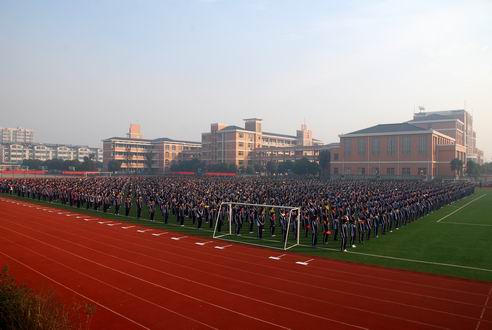
我校外教布朗宁.克拉克先生新年献词
Principal Wang, teachers, and students: I am honoured to speak to you today.
In the short time I have, I would like to discuss three themes. First: the idea that New Years is both relative and yet universal. Second: New Years is a time for renewal and improvement. Thirdly, renewal and improvement should not be limited to an annual ritual. I will also digress briefly about the significance of today for western culture.
The idea of a New Year is similar across the world, and yet different. Muslims count years by the moon, the west follows the sun and the Chinese do a bit of both.
In the west, New Year’s Day was not always January 1st. The Romans started their year in March. If you translate Latin directly into Chinese, “September”, “October”, “November” and “December” actually mean qi yue, ba yue, jiu yue and shi yue.
It is all very artificial. Today is December 26th, what we call “Boxing Day”. The tradition is that the rich people who exchanged gifts on Christmas would take the empty boxes and fill them with food to give to their workers and poor people. That was many years ago and now – well, about 12 hours from now – Canadians and Americans will engage in a shopping frenzy at stores offer Boxing Day sales. We will buy many things for ourselves, most of which are made in China.
Setting aside Boxing Day, my point is that picking any particular day is arbitrary. Until 1752, England had March 25th as New Years. Hindus celebrate New Years in April. Some cultures use March 21st – the vernal equinox. With all these differences, it is still a common human idea, and that is my second theme.
New Year’s is about renewal. For the Romans, January was the month of their god Janus, who had two faces: one facing forward and one looking back. We think about the past year but set aside our mistakes and misfortunes, wish each other the best of luck, and we try to be better and do better in the coming year. In Chinese, gong xi fa cai. In Canada, we make a “New Year’s Resolution” where we promise ourselves to be better: to get better marks, to be less fat, to improve our work unit, our school or our family; but most of all, improve ourselves.
My third point is this: everything that ends is a new beginning. My wu shu teacher told me: perfection is not a destination, it is a direction. We are only human and we will always be flawed. That does not mean we cannot be better people than we are today. To be always improving, that is as perfect as any of us can hope to be. Different cultures mark the New Year at different dates but there is a common desire to be better.
The idea I will end with is this: why only once a year? Why not every day? A culture or nation only celebrates this once per year, but as every day ends a new one begins and as we wake up each morning – each one of us as individuals –why not take a few minutes before breakfast to think about how we can be better today than we were yesterday? We can do that today, on Boxing Day. We can do that on January 1st. We can do that January 23rd. I think we can do that every day.
I wish you good luck. However, improvement is a matter of choice, not luck. Please choose wisely today and every day. Thank you.